
The story of Jerusalem’s second temple begins with an unlikely decree from a pagan king.
In 538 BC, Cyrus the Great of Persia conquered Babylon and issued an order allowing the Jewish exiles to return to Jerusalem and rebuild the temple that Nebuchadnezzar had destroyed. Cyrus even returned the sacred vessels that had been carried away from the temple decades earlier.
Ezra records Cyrus’s remarkable decree:
“Thus says Cyrus king of Persia: The LORD, the God of heaven, has given me all the kingdoms of the earth, and he has charged me to build him a house at Jerusalem.”
Ezra 1:2, ESV
The exiles went home. In 537 BC, nearly 50,000 Jews returned under Zerubbabel, governor of Judah, and Joshua the high priest. They rebuilt the altar first, then began laying the foundation of the temple.
When the foundation was finished, the people celebrated, though not everyone was celebrating for the same reason. Some shouted for joy at seeing the temple begin to rise again, while the older generation wept because they remembered Solomon’s temple before its destruction.
“And all the people shouted with a great shout when they praised the LORD, because the foundation of the house of the LORD had been laid.”
Ezra 3:11, ESV
Then opposition arose.
The surrounding peoples offered to help with the rebuilding, but Zerubbabel and the Jewish leaders refused their assistance. Hostility followed. Their opponents began discouraging the builders and eventually sent accusations to the Persian authorities, claiming that Jerusalem had a history of rebellion and that rebuilding the city could threaten Persian control.
The accusations succeeded, and construction stopped.
For sixteen years, the temple remained unfinished.
The people eventually settled back into ordinary life, building houses for themselves while God’s house remained in ruins. Then, in 520 BC, the prophets Haggai and Zechariah called them back to the work. Haggai’s message was simple:
“Consider your ways.”
Haggai 1:5, ESV
The people listened. Zerubbabel led them in rebuilding, and this time the work continued. In 515 BC, the second temple was finally completed.
After decades of exile, Jerusalem had its temple again.
But Jerusalem Wasn’t Finished With Trouble
The temple would stand for centuries, though the city around it remained vulnerable. In 445 BC, Nehemiah returned from Persia and found Jerusalem’s walls broken down and its gates burned with fire (Nehemiah 1:3). He led the effort to rebuild them while facing threats and opposition from Sanballat, Tobiah, and others.
Jerusalem was becoming secure again, but a new age was approaching.
Alexander Arrives

In 332 BC, Alexander the Great swept through the ancient Near East, bringing Jerusalem under Greek control as the Persian Empire collapsed.
A famous later account claims that Alexander entered Jerusalem and honored the Jewish temple, though the story appears to have been embellished. What followed, however, is certain enough: after Alexander’s death, his empire fractured, and Jerusalem eventually came under the Seleucid kingdom.
Under Antiochus IV Epiphanes, the temple faced a far greater crisis.
The Temple Is Desecrated
Antiochus plundered the temple in 175 BC. Then, in 167 BC, he went further. Jewish sacrifices were stopped, the temple was defiled, and an altar dedicated to Zeus was established there.
For the Jews, this was a direct assault on their worship, and rebellion followed.
Judas Maccabeus and his followers eventually recaptured Jerusalem, cleansed the temple, and restored Jewish worship. On December 25, 164 BC, the temple was rededicated, an event remembered in the Jewish festival of Hanukkah.
The temple had endured another devastating chapter, but Jerusalem’s political troubles continued.
Rome Enters the Story
In 63 BC, Jewish political conflict brought the Roman general Pompey to Jerusalem. After conquering the city, Pompey entered the temple and even went into the Holy of Holies.
The intrusion would have been shocking. Leviticus 16 restricted entrance to the Holy of Holies to the high priest, and even he could enter only once a year on the Day of Atonement.
Jerusalem was now under Roman power.
The Temple Jesus Knew

By the time Jesus walked through Jerusalem, the second temple had stood for centuries. Herod the Great had undertaken a massive renovation and expansion, transforming the temple complex into one of the most impressive structures in the ancient world.
This was the temple where Jesus was presented as an infant (Luke 2:22–24), where He astonished the teachers as a twelve-year-old (Luke 2:41–52), and where He later drove out the money changers.
It was also the temple whose destruction Jesus predicted.
As His disciples admired the buildings, Jesus told them:
“There will not be left here one stone upon another that will not be thrown down.”
Matthew 24:2, ESV
The prediction must have sounded extraordinary. The temple had already endured centuries of conquest and upheaval, and Herod had only recently transformed it into a magnificent complex.
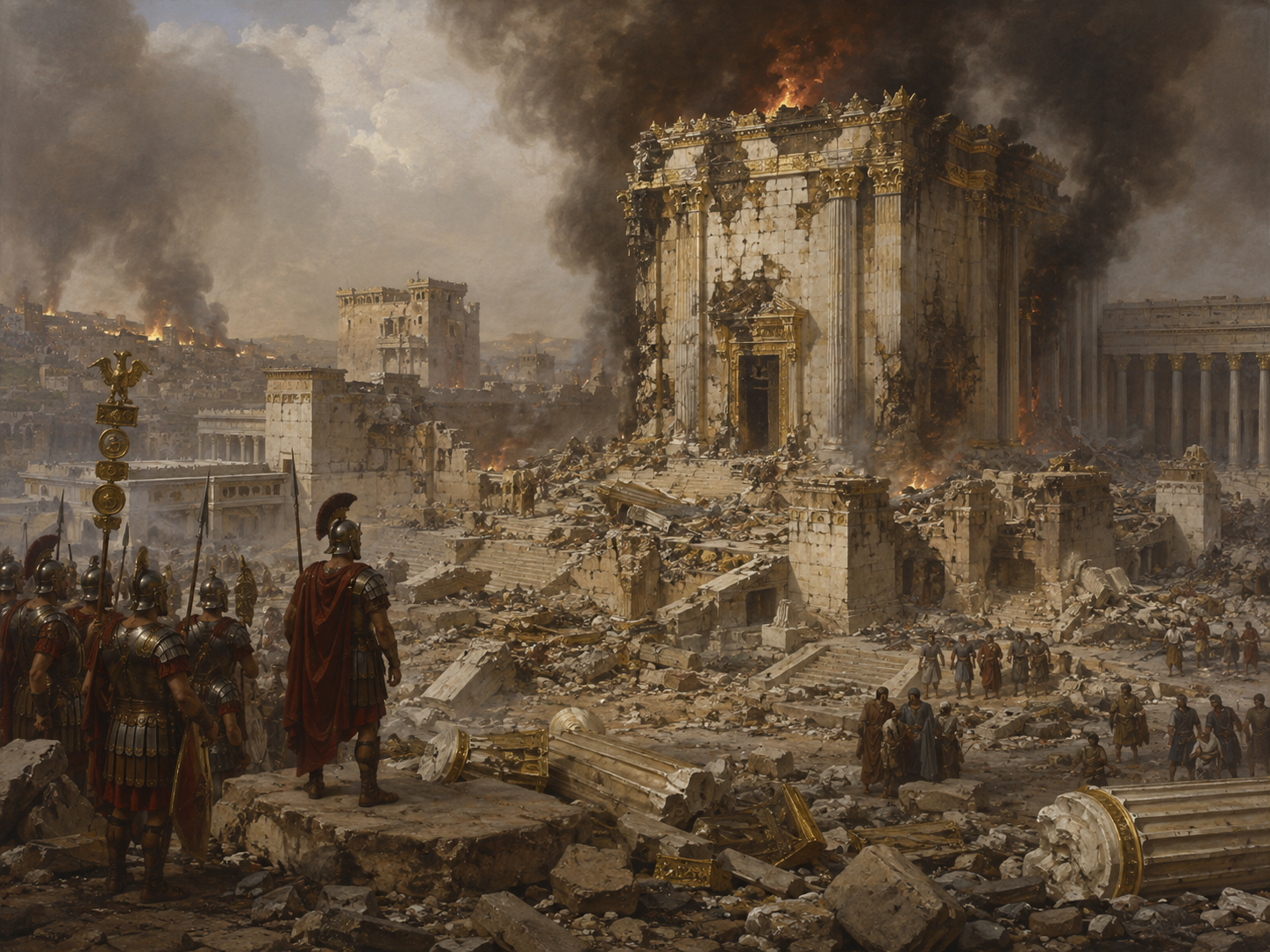
Yet in AD 70, Roman armies under Titus surrounded Jerusalem, captured the city, and destroyed the temple.
Nearly six centuries after Zerubbabel completed it, the second temple was gone.
But the temple’s story does not end with its destruction. Earlier in His ministry, Jesus had made a statement that would take on new meaning after AD 70:
“Destroy this temple, and in three days I will raise it up.”
John 2:19, ESV
John explains that Jesus was speaking about “the temple of his body” (John 2:21).
For centuries, the temple had stood at the center of Israel’s worship and served as the place associated with God’s presence among His people. By the time the Romans reduced it to ruins, the Gospels had already revealed where that presence was ultimately found.

Leave a Reply